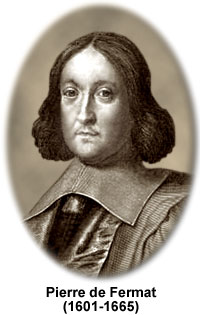
CLARIFICATION AND EXPLANATION OF CLOSE’S 1965 PROOF
OF
FERMAT’S LAST THEOREM
By Edward R. Close PhD
“Concerning
whole numbers, while certain squares can be separated into two squares, it is impossible to separate a cube into two
cubes or a fourth power into two fourth powers or, in general any power greater
than the second into two powers of like degree. I have discovered a truly marvelous demonstration, which
this margin is too narrow to contain.” - Pierre de Fermat, circa 1637 [1]
ABSTRACT:
Fermat’s last theorem
(FLT) states that no three positive integers X1, Y1, and
Z1 can satisfy the equation xn +yn = zn
for any integer value of n greater than two. Though a proof was claimed by
Pierre de Fermat in 1637, it was never found and Fermat’s Last Theorem remained
officially without proof until Andrew Wiles published an extensive solution in
1995. Prior to that, however, Edward Close in 1965 provided a solution and
submitted a proof, which he then published in 1977 (FLT65). The Close proof
though never refuted presented difficulties for reviewers because of the
unconventional notation used and three reviewers have suggested that the
difference between algebraic polynomial factors and integer factors as used
made the proof unclear and possibly incorrect. In this paper, Close provides
FLT65C as a clearer rewrite of FLT65. He also demonstrates that FLT65 provided
a true and adequate proof of FLT. The FLT65 proof remains unchanged in this
presentation but adherence to conventional notation makes it clearer, and the
polynomial critique is shown to be irrelevant in this rewrite (FLT65C).
Additionally, the fact that the case of the exponent N=2 is excluded from the
proof is shown more clearly. This paper provides a 2-page FLT65C solution, and
then in the discussion amplifies and clarifies areas that may help reviewers
understand the proof. Several pertinent appendices are attached. Appendix A
demonstrates the proofs of the division algorithm and corollaries because they
are central to the proof. Additionally, the application of primes and relative
primes is an important part of the proof of FLT65: Appendix B shows the proof
of sufficiency for X, Y and Z relatively prime and N = primes > 2, in any
proof of FLT. And importantly, Appendix C provides the original FLT65 published
proof.
INTRODUCTION
Sometime around 1637, Pierre de Fermat scribbled a
brief statement in Latin in the margin of a book on Diophantine equations. This
theorem came to be known as “Fermat’s Last Theorem” (FLT), because it remained
without a known proof for more than three centuries. In modern representation,
FLT is stated as follows: No three positive integers X1, Y1,
and Z1 can satisfy the equation xn +yn = zn
for any integer value of n greater than two. The first generally accepted proof has been attributed
to Sir Andrew Wiles, who is said to have spent seven years completing it. Dr.
Wiles’ proof was published in 1995.
In 1965, three decades before Wiles’ proof was
announced, I (Edward R. Close) had produced a proof of FLT. At the time, I had
completed my BA degree in mathematics with a minor in physics, one semester of
a Master’s program in theoretical physics, and had been teaching mathematics
for three years. The 1965 proof was submitted to a mathematician at Iowa State
University. He returned it with a note saying that “It could not be a valid
proof because it would apply to the case n = 2”. From his response, I knew he
had not read past the first page, because the case n = 2 was eliminated on the
second page. I learned that most professional mathematicians consider reviewing
a purported proof of FLT a waste of time, and look for anything that appears to
be an error and reject the “proof” as quickly as possible. I was very
discouraged and went on with my life, but later published my proof anyway in an
appendix of “The Book of Atma”. [2] Over the years, my 1965 proof of
Fermat’s Last Theorem (FLT65) has been submitted to a number of professional
and amateur mathematicians for review and comment. The responses from those to
whom the proof was submitted fall into one of the following categories:
1.
Some declined to
look at it either because they didn’t have the time or they didn’t want to take
the time to review it.
2.
Some refused to
look at it because number theory was not their field of expertise and/or interest.
3.
Some refused to
look at it because they did not believe a simple proof of FLT possible.
4.
Several of the
reviewers found nothing wrong with the proof.
5. Some
of the reviewers found the argument inconclusive.
Those who found the argument inconclusive cited one
or both of the following reasons:
i.
They found the
notation unclear or confusing.
ii. They
were concerned that conclusions drawn from the factorization of the FLT
equation, xn + yn = zn, as a polynomial in n,
might not apply to the numerical factorization of the polynomial for some
specific integer solution (X1, Y1, Z1),
providing a potential loop-hole in the proof.
The notation in the 1965 proof may have confused
readers because it is non-standard and not as well defined as it should have
been. At the time, I used unconventional notation deliberately because I
thought it made it easier to distinguish when the arguments were being
considered as variables from when they were being considered as specific
integers. The subscript identified an algebraic symbol as an integer, as
opposed to a variable. I failed, however, to provide a notation that
distinguished between integer variables and specific integer constants, and
this was problematic because confusion may arise if a specific notation is not clearly
defined and its use properly justified. Therefore, in this discussion, I will
use three types of notation precisely defined for greater clarity:
·
Lower-case letters, like x, y and z represent
variables with no numerical restrictions.
·
Upper-case letters like X represent variables
restricted to integers.
·
Upper-case letters with subscripts like X1
represent specific integer values of the variables.
In addition, we will distinguish
between integer factors and algebraic factors as follows:
·
g(x) e f(x) means the
polynomial g(x) is an algebraic factor of the polynomial f(x), or stated
another way, g(x) is contained in f(x) as an algebraic factor; and
·
A ∈ B means A is an
integer factor of the integer B, or A is contained in B as an integer factor.
·
Consistent with
≠, meaning “is
not equal to”, the oblique strike through a symbol will indicate the negation
of the symbol; e.g.: g(x) ɇ f(x) means g(x) is not an algebraic factor of the
polynomial f(x) and A ∉ B means A is
not a factor of B.
My position has been, and remains, that FLT65, my
1965 proof, is conclusive and complete, even though the notation may be
confusing. I maintain this position for two simple reasons: (A) The division
algorithm and corollaries applied in the proof are valid over the entire field
of real numbers, which includes the integers, and (B) Application of the
division algorithm to the FLT equation produces a unique remainder that allows
us to determine the numerical type of the third variable when two of them are
assumed to be integers.
Reviewers in
category 5 above, with concern number ii, thought that conclusions drawn from
the factorization of the FLT equation, xn + yn = zn, as a polynomial in
z, might not apply to the numerical factorization of the polynomial for some
specific integer solution (X1, Y1, Z1). While
this is a legitimate concern, it is dispelled by detailed clarification of
notation and step-by-step explanation of the reasoning.
After this
introduction, I will present the mathematics of FLT65 with no more discussion
than is necessary to be complete. Then I will present a
more detailed discussion and explanation of the proof, showing how unique
features of the FLT equation provide proof that X, Y and Z cannot all three be
integers, and how this eliminates concern number ii above.
The Division
Algorithm and three Corollaries, presented
briefly below, are central to this proof, and their proofs were included in
FLT65. In order to make this presentation as complete as possible, these
supplementary proofs are included in Appendix
A.
The division
algorithm states that if g(x) ≠ 0 and f(x)
are any two polynomials over a field, of degree m and n, respectively, and n >
m, then there exist unique polynomials q(x) and r(x) such that f(x) = q(x)g(x)
+ r(x), where r(x) is either zero or of degree smaller than m.
Corollary I states that if
f(x) and g(x) contain a common factor, r(x) contains it also.
Corollary II states that
the remainder, r(x), when f(x) is divided by (x-a) is f(a).
Corollary III states that a
polynomial, f(x), of degree greater than one x-a, IF AND ONLY IF, f(a) = 0.
To prove FLT, it is necessary to show that for n ≥
3, there is no solution (X1,Y1, Z1) such that
X1, Y1 , and Z1 are integers. It is necessary
and sufficient to show this for n = p, where p is a prime number and X1,
Y1 and Z1 are relatively prime. Proofs of these two
statements are given in the 1965 proof. They are relatively simple and
well-known. For efficiency they are not included in the proof below, but for
completeness and clarity, they are included in Appendix B. The method employed in the 1965 proof of FLT, is to
show that if we restrict x and y to the field of integers, z cannot be an
integer. Clearly, when this is shown, FLT is proved.
FERMAT’S LAST THEOREM (FLT)
(A TWO PAGE PRESENTATION OF THE CLOSE 1965 PROOF [FLT65C])
Consider the equation zp – xp = yp. …… equivalent to Equation (1) in the 1965 proof. Since p
is a prime number > 2, and thus an odd prime, we can factor the left side of
the equation to obtain:
(z-x)( zp-1 + zp-2x
+ zp-3x2 +•••+ xp-1)
= yp…… equivalent to Equation (2) of FLT65C.
For variable integer values of x,
represented by X, let zp-1 + zp-2X
+ zp-3X2 +•••+ zXp-2
+ Xp-1 = f(z),
and z-X = g(z). Then g(z)f(z) = Yp,
for all integer values X and Y. …… Equation
(3) of FLT65C
For
Fermat’s last theorem to be falsified, X, Y and z must be integers, so we will
replace X and Y with X1 and Y1, representing specific integers.
But, since we do yet not know whether z can actually be an integer if x and y
are integers in an FLT solution, we must continue to represent it by z, a
variable over the field of real
numbers.
By
Corollary
I of the DIVISION ALGORITHM,
since f(z) and g(z) are polynomials in z of degree n = p -1 and m = 1, respectively,
when f(z) is divided by g(z), the remainder, r(z), will contain any and all algebraic factors common to both.
And by COROLLARY II, the remainder when f(z) is divided by g(z) will be
f(X1). And so:
r(z) = f(X1).= X1p-1
+ X1p-2X1 + X1p-3X12
+•••+ X1p-1 = pX1p-1, a unique
constant made up of integer factors for any p > 2. … Equation (4.).
Since for any solution of Equation
(1), X1, Y1 and z, if an integer, may be
considered to be relatively prime, no factor of X1, and, therefore,
of X1p-1, may be contained in g(z) = z –X1. Therefore,
if f(z) and g(z) have a common factor, it must be p. It also follows that
for
their product to be equal to the perfect p-power, (Y1)p,
either p ∈
f(z), p ∈
g(z), or they must both be perfect p-powers of integers.
By exactly the
same reasoning as above, we can write the FLT equation as zp – yp
= xp and factor as:
(z-Y)(
zp-1 + zp-2Y + zp-3Y2 +•••+ Yp-1)
= Xp. … Equation (5)
Let
zp-1 – zp-2Y1
+ zp-3Y1 2
-•••+ Y1 p-1 = f1(z) and z - Y1 = g1(z).
Then, dividing
f1(z) by g1(z), analogous to Equation (4), we obtain r1(z)
= pX1p-1… Equation
(6)
Then,
either p ∈
f1(z) and p ∈
g1(z), or they are perfect p-powers of integers.
For a given case of zp = X1p + Y1p,
it is possible that either p ∈ f(z) or p ∈ f1(z). But, if p is a factor
of one, the other has to be a perfect p-power, since X1 and Y1,
and therefore, f(z) and f1(z) are relatively prime. For a given z =
Z1, either p ∈
f(Z1) → p ∈ Y1,
or p ∈
f1(Z1) → p ∈ X1.
If neither X1.nor Y1 contains p, because they are
relatively prime, both must be perfect p-powers. Therefore, in any event, one
of them at least, must be a perfect p-power, not containing p as a factor.
Since f(z)
and f1(z) are both of the same form, we may choose either one
or the other as not containing p. So we may choose f(z)
= zp-1 + zp-2X1 + zp-3X12 +•••+ X1p-1
= Ap, with A ∉
p.
By the Division
Algorithm, for the two polynomials, g(z) ≠ 0 and f(z), over the field of real
numbers, with degrees m and n respectively, and n > m > 1,
there exist unique polynomials q(z) and r(z) such that f(z) = q(z)g(z) + r(z),
where r(z) is either zero or of degree smaller than m.
If
n = m = 1, as in the case when p = 2, or if f(z) is not equal to an integer
raised to the pth power, as in that case when A is not an integer,
but is the pth root of a prime number, q(z) and r(z) are not unique
and COROLLARY II does not hold. Thus,
this proof does not apply to the case n = 2, or to non-integer solutions of the
FLT equation. But when p > 2, and we assume there is an integer solution
of equation (1), because the set of
real numbers is closed with respect to addition, for any value of z, there is
some real number s, such that z – s = A, and COROLLARY II tells us that if g(z) = z – s, a polynomial of degree
1 in z, q(z) and r(z) are unique and
the remainder, r(z) will be of degree m < 1 = zero degree, and of the form
f(s). Therefore: f(z) = (z-s)q(z) + f(s) over the field of real numbers, and by
COROLLARY III, f(z) e (z – s), IF AND ONLY IF, f(s) = 0. Thus when p
>2, we have:
(z – s) e f(z) → f(s) =
sp-1 + sp-2X1 + sp-3X12
+•••+ X1p-1 = 0….Equation
(7).
Since both s and z can take on any real number
value, if they are not integers, f(s) = 0 is not a contradiction because there
are an infinite number of real number solutions for the FLT equation. But the
Division Algorithm and Corollaries hold over the field of real numbers,
including integers, so for specific integer values z = Z1, s = S1
and A = A1, (z – s) e f(z) →(Z1 – S1) ∈ f(Z1)
→ f(S1) = 0.
But f(S1) = S1p-1
+ S1p-2X1 + S1p-3X12
+•••+ X1p-1 = 0 is an impossibility
because X1 and S1 are positive integers, and the sum of
positive integers cannot equal zero.
Therefore, for specific integer values z = Z1,
s = S1 and A = A1, (Z1 – S1) ∈ f(Z1)
→ f(S1) ≠ 0, and thus
g(z) = (Z – S)
∉ f(z)
= zp-1 + zp-2X1 + zp-3X12
+•••+ X1p-1.
But, for there to be a triple integer solution for
the FLT equation, falsifying FLT, there must be specific integers X1,
Y1, Z1, A1, and S1, such that (Z1
– S1) = A1, and f(Z1) = A1p,
therefore:
(Z1 – S1) ∉ f(Z1) → A1
∉
A1p and we have a clear contradiction, proving Fermat’s
Last Theorem (FLT65).
DISCUSSION
AND EXPLANATIONS
OF
THIS PROOF OF FERMAT’S LAST THEOREM (CLOSE FLT65C)
This is the same proof FLT65C but with detailed
discussions and explanations:
Using the notation outlined in the introduction, we
can write: zp – xp = xp. This is equation (1) in the 1965 proof, without
the restriction of x, y and z to integer values.
Since p is a prime number, we can factor
the left side of the equation to obtain
(z-x)( zp-1 + zp-2x
+ zp-3x2 +•••+ xp-1)
= yp, equation
(2) of the up-dated 1965 proof
In the 1965 proof (FLT65), the FLT equation is expressed
as an N-degree polynomial in the variable Z. This translates to a p-degree
polynomial in the variable z in the current standardized notation. The
rationale for this approach to proving FLT by focusing on one of the variables
as an independent unknown is based on the fact that any equation in three
unknowns, including the FLT equation, has an infinite number of solutions, but,
if we arbitrarily choose values for two of the variables, we can solve for the
third. In a similar manner, if two of the variables of the FLT equation are restricted
to the field of integers, we will be able to determine whether any values of
the third variable can be integers.
In FLT65, Close focused on z as the independent
unknown by setting X = X1 and Y = Y1, intending only to
imply that they were integer variables. Later on, I indicated that they were
specific integer values, without changing the way they were represented. This
lack of clear definition of notation is at least part of the confusion that
gave rise to the concern #ii.
My thinking was that taking the trouble to
distinguish between variables and specific values of the variables was
unnecessary because the division algorithm and
corollaries apply to both, as ultimately, whatever their values, they are
elements of the field of real numbers. Reviewers, however, have pointed out
that this is not necessarily true for polynomials in general. It turns out to
be the case in this instance, however, because of the unique form of the FLT equation and
the requirement that the only solutions being considered are those for which
all three variables have integer values.
Because at least three of the most
qualified reviewers of FLT65 raised the concern about the applicability of the
algorithm and corollaries to factors of integers, it is clear that the proof is
difficult to follow unless one proceeds through the whole process with clearly
defined and justified notation. When this is done
below, we see that the legitimate application of the algorithm and corollaries
to variable polynomials derived from the FLT equation leads to an unavoidable
contradiction that proves FLT.
In this more detailed explanation, we will adhere to
the notation defined above, viz. we will use x, y and z for unrestricted
variables over the field of real
numbers, X, Y and Z for variables restricted to the sub-set of real numbers
that make up the ring
of integers, and X1, Y1, and Z1 for specific
integers; and for clarity, we will distinguish between integer factors and
algebraic factors as follows:
g(x) e
f(x) means the polynomial g(x) is an algebraic factor of the polynomial f(x),
or stated another way,
g(x) is contained
in f(x) as an algebraic factor; and A∈ B means A is
an integer factor of the integer B, or A is contained in B as an integer
factor. Also, consistent with ≠, meaning “is
not equal to”, the oblique strike through will indicate the negation of
negation of the symbol; e.g.: g(x) ɇ
f(x) means g(x) is not an algebraic factor of the polynomial f(x) and A ∉ B means A is
not a factor of B.
For
variable integer values of x, represented by X, let zp-1 + zp-2X
+ zp-3X2 +•••+ zXp-2
+ Xp-1 = f(z)
And
z-X = g(z). Then
(3.) g(z)f(z) = Yp,
for all integer values X and Y.
For
Fermat’s last theorem to be falsified, X and Y must be specific integers, call
them X1 and Y1, and z must also be an integer. But, since
we do not yet know whether z can actually be an integer in the FLT equation, we
must continue to represent it by z, a variable over the field of real numbers.
By
Corollary
I, since f(z) and g(z) are polynomials of degree n = p -1 and m = 1,
respectively, over the field of real numbers, when f(z) is divided by g(z), the
remainder, r(z), will contain any and all factors common to both. See Appendix
A for the proof of this.
And
by COROLLARY II, the remainder when
f(z) is divided by g(z) = z - X1, will be f(X1). And so:
(4.) r(z) = f(X1).=
X1p-1 + X1p-2X1
+ X1p-3X12
+•••+ X1p-1 = pX1p-1, a unique
integer for any p > 2. Interestingly, it is this unique integer remainder
in
the case of the FLT equation that will allow us, to extend the application of
the division algorithm from variable polynomials over the field of real numbers
to integers, a subset ring of the field of real numbers.
Since for any integer solution of equation
(1), X1 and Y1 may be considered to be relatively
prime, no factor of X1, or, therefore, of X1p-1,
may be contained in g(z) = z –X1, because, if z is to be an integer,
z –X1 must contain a factor of Y1. Therefore, if f(z) and
g(z) have a common factor, it must be p. It also follows that for
their product to be equal to the perfect p power, (Y1)p,
one of them, i.e. either f(z) or g(z), must contain p or they must be both perfect
p-powers of integers.
Similarly, we
can factor the FLT equation as
(5.) (z-Y)( zp-1
+ zp-2Y + zp-3Y2
+•••+ Yp-1) = Xp. And by
exactly the same reasoning as above, for any particular Y = Y1, we can
have
zp-1 – zp-2Y1
+ zp-3Y1 2
-•••+ Y1 p-1 = f1(z) and z - Y1 = g1(z).
Then,
either f1(z) and g1(z) contain p as a single common
factor, or they are perfect p-powers of integers. So for a given case of zp = X1p + Y1p
, if either f(z) or f1(z) contains p, the other has to
be a perfect p-power, since we have concluded that we only have to consider
relatively prime X, Y and Z, implying both cannot contain p. Now, p e f(z) → p ∈
Y1 and p e f1(z) → p ∈ X1.
But X1.and Y1 are relatively prime. If neither X1.nor
Y1 contains p, both, being relatively prime, must be perfect
p-powers. Therefore, in any event, one of them at least, must be a perfect
p-power, not containing p as a factor.
Therefore, we
may choose f(z) = zp-1 + zp-2X1
+ zp-3X12
+•••+ X1p-1 = Ap, and/or
f1(z)
= zp-1 – zp-2Y1
+ zp-3Y1 2
-•••+ Y1p-1 = Bp, A and B integers, and at
least one, A or B, does not contain p. Also note that since g(z)f(z) = Y1p, and f(z) = Ap,
A ∈
Y1 and since g1(z)f1(z)
= X1p, f1(z) = Bp,
B ∈
X1.
Since f(z) and f1(z) are both of the same form,
we may choose either of them as the one not containing p. So we may choose f(z) = zp-1 + zp-2X1
+ zp-3X12
+•••+ X1p-1 = Ap, and A will not contain p.
We cannot, at
this point, assume that z = Z1, a specific integer, for some x = X1
and y = Y1, because this cannot be justified unless we can show that
the requirement that f(z) = Ap does
not lead to a contradiction.
For any value
of X1, the conditions f(z) = Ap, and A ∈
f(z)
are necessary conditions for an integer solution of the FLT equation to exist.
And since A is a positive integer variable, with any specific X1
< Y1 < any z = Z1 that will satisfy the FLT
equation, we can set A = z – S, where z is an unrestricted variable, and S is a
positive integer variable. Note that S is a variable over the ring of integers. Because we don’t know
whether z can be an integer, the specific value of S, S1, when X = X1,
is dependent on the specific integer value, A1, of A.
The division algorithm tells us that for two
polynomials, g(z) ≠ 0 and f(z), over the field of real numbers, with degrees m
and n respectively, and n > m > 1, there exist unique
polynomials q(z) and r(z) such that f(z) = q(z)g(z) + r(z), where r(z) is
either zero or of degree smaller than m.
Notice
that if n = m = 1, as in the case when p = 2, or if f(z) is not equal to an
integer raised to the pth power, as in that case when A is not an
integer, but is the pth root of a
prime number, q(z) and r(z) are not unique and COROLLARY II does not hold, and this proof does not apply to the
case n = 2, or to non-integer solutions of the FLT equation. But when p >
2, and we assume there is at least one solution of equation (1) where x, y and z are equal to integers, COROLLARY II tells us that if g(z) = z
– s, which is a polynomial of degree 1 in z, q(z) and r(z) are unique and the remainder, r(z) will be of degree m < 1 =
zero degree, i.e., a constant, of the
form f(s).
Therefore: f(z)
= (z-s)q(z) + f(s) over the field of real numbers, and by COROLLARY III, f(z) is divisible by z – s, IF AND ONLY IF, r(z) = f(s) = 0. Thus when p >2, we have:
(6.) (z – s) e f(z) →
f(s) = sp-1 + sp-2X1 + sp-3X12
+•••+ X1p-1 = 0.
Since both s and z can take on any real
number value, if they are not integers, f(s) = 0 is not a contradiction and
there are an infinite number of real number solutions for the FLT equation.
But, if s is to be from the ring of integers, f(S) = 0 is a contradiction.
Since the Division Algorithm and Corollaries hold
over the field of real numbers, including integers, for specific integer values
z = Z1, s = S1 and A = A1, (z – s) e f(z) →(Z1
– S1) ∈
f(Z1) →
f(S1) = 0.
But f(S1) = S1p-1
+ S1p-2X1 + S1p-3X12
+•••+ X1p-1 = 0 is an impossibility because X1
and S1 are positive integers, and the sum of positive integers
cannot equal zero. Therefore:
g(z) = (z – S) cannot
be a factor of f(z) = zp-1 + zp-2X1
+ zp-3X12 +•••+ X1p-1.
Furthermore, because the division algorithm and corollaries apply across the
field of real numbers, including the integers, it
follows that, for any real values of z, S and A, for there to be a triple
integer solution for the FLT equation, falsifying FLT, there must be specific
integers X1, Y1, Z1, A1, and S1,
such that z = Z1 , S = S1 and A = A1, and
for the FLT equation, (z – S1) = A and f(z) = Ap,
therefore:
(z – S) ɇ
f(z) →(Z1 – S1) ∉ f(Z1)
→ A1 ∉
A1p and we have a clear contradiction, proving FLT.
Note that f(z)
and g(z) are polynomials in the variable z throughout the entire discussion, up
to the contradiction S1p-1 + S1 p-2X1
+ S1p-3X12 +•••+ X1p-1
= 0; and also note that because the division algorithm and corollaries apply
across the field of real numbers, including the integers, we justified
substituting integers, that have to
exist in order for FLT to be falsified, into the algebraic forms to obtain the
integer factors for
the hypothetical triple integer solution of the FLT equation.
When the
author did this, he found that the contradiction obtained by assuming that for given integer values of x
and y, an integer z was possible also applied
to the integer factors as well as the algebraic factors. Therefore the concern that the factorization of XN + YN =
ZN, as a polynomial in Z, might not provide a contradiction
in the numerical factorization of the polynomial for some specific integer
solution, i.e., concern #ii is not relevant, and the proof of FLT is complete.
However, if the reader is not convinced by this argument, we can address
concern #ii in additional detail as follows:
Given f(S) ≠
0, the fact that the integers form a ring, which is a sub-set of the field of real numbers,
but technically not a field because
the integers are not closed with respect to division, might lead us to believe
that for some Z1 that might satisfy the FLT equation
along with X1 and Y1, the remainder r(S1) =
f(S1) = S1p-1 + S1p-2X1
+ S1p-3X12 +•••+ X1p-1,
not being zero, might contain g(z) = (z – S1) = A1 as a
factor. Assuming that there is such
an actual integer triple solution for the FLT equation, the integers X1,Y1,
Z1, and p might be so large that it would take a million years for
the fastest computer available to search for and find this integer solution.
The point is that it is possible that there could
be an integer solution that we could never find by trying endless combinations
of integers from the infinite ring of relatively prime integers. But we can set up a process of infinite
descent4 by referring to the simple process of long division.
In the process of long division, first we estimate
the quotient. Next we multiply our estimate by the divisor, and then subtract
the result from the dividend. If the remainder is greater than the divisor, we
increase the quotient estimate and repeat the process until the remainder is
either zero or less than the divisor. We can follow this same simple procedure
with f(S) as the dividend, g(S) as the divisor and r(S) as the remainder, where
S is an integer variable over the ring of integers from which the specific
integers of a specific solution of the FLT equation must come if FLT is to be
falsified.
Because the ring of integers is closed with respect
to addition, for every value of S, there is some integer value of K, such that
g(S) = S – K = A. Since the remainder, r(z) = f(S) ≠
0, let’s assume it contains the divisor, A = S - K, i.e., (S – K) e
f(S), as it must be for concern #ii
to have any validity. Remembering that A, Z and S must all be integers for FLT
to be falsified, and due to the well-ordered nature of the ring of integers,
allowing for the basic operations of addition and subtraction, there is some
(X,Y,Z) = (Xi,Yi,Zi), specific integers, such
that A = Zi – S and there is also some specific integer K, such that
A = Zi – S = S – K. Then dividing f(S) by S – K, in accordance with the
Division Algorithm, we get a remainder equal to f(K):
(7.) f(K) = Kp-1 + Kp-2Xi
+ Kp-3Xi2 + ••• + Xip-1
Since S – K = A, and A has to be a positive integer in order for FLT to be falsified, K
< S, and f(K) < f(S). Just as in simple long division, we can repeat this
process with A = K – K1, K1 < K, and with smaller and
smaller Ki until the remainder, f(Ki) obtained is either
zero or smaller than A. No matter how large or small the integers of the FLT
falsifying solution are, and how large the remainder f(S) may be, the process
of infinite descent obtained
by successively dividing by A will eventually reduce f(Ki) for that
solution to its smallest possible integer value. Now, in order for FLT to be
falsified, f(S) must contain A, and for FLT to be falsified, the smallest
integer value of f(Ki) must be equal to zero. In our infinite
descent, the smallest possible f(Ki) will occur when Ki
=1.
But, the smallest possible f(Ki) = f(1) =
1 + Xi + Xi2 + ••• + Xip- 1,
which is still a sum of positive integers, and thus cannot equal zero, or
contain A, as it must for FLT to be falsified. This constitutes an infinite
descent resulting in a contradiction. Assuming that for xp + yp
= zp, x = X1 and y = Y1, X1 and Y1
specific integers, we reach the contradiction of an infinite descent, proving
that z ≠ Z, Z ≠
Z1, and f(z) ≠ Ap,
a perfect pth power of an integer, and all sufficient and necessary
conditions for the definitive proof of FLT have been met.
Therefore, we may state
unequivocally that the equation xp + yp = zp
has no solutions in positive integers when p is an integer > 2, and the
proof of Fermat’s last theorem is complete.
APPENDIX A:
PROOFS OF The Division Algorithm and Corollaries
The Division Algorithm
THEOREM: (The division
algorithm) If g(x) ≠ 0 and f(x) are any two polynomials over a field, of degree
m and n, respectively, and n>m, then there exist unique polynomials q(x) and
r(x) such that
(A) f(x) = q(x)g(x) + r(x)
Where
r(x) is either zero or of degree smaller than m.
Let
f(x) = anxn + an-1xn-1 +•••+ a1x
+ a0
And g(x) = bmxm
+ bm-1xm-1 +•••+ b1x + b0, bm ≠0.
If
q(x) is zero or of a degree smaller than m we have
f(x) = 0•g(x)
+ f(x)
and if n = m,
q(x) becomes a constant, Q, and r(x) may be of any degree from zero to n,
depending on the value of the constant Q. Thus q(x) and r(x) are not unique in
this case.
Now
we can form f1(x), of lower degree than f(x), by writing
(B) f1(x) = f(x) - an/am
xn-m •g(x).
We may now
complete the proof of this theorem by induction: Assume the algorithm true for all
polynomials over the field. Since f1(x) is such a polynomial, we may
write:
(C) f(x) = q1(x)g1(x) + r1(x),
where r1(x)
is either zero or of a degree less than m. So from (B) and (C):
f(x)
= | an/am xn-m + q1(x) | g1(x)
+ r1(x).
or f(x) =
Q(x)g(x) + R(x), the desired form of f(x). All that remains is to prove that
Q(x) = q(x) and R(x) = r(x), that is, that q(x) and r(x) are unique when
m>n.
Now, f(x) =
q(x)g(x) + r(x)
And f(x) =
Q(x)g(x) + R(x).
This implies
Q(x)g(x) + R(x) = q(x)g(x) + r(x), or [Q(x) – q(x)]g(x) = r(x) – R(x).
If m = n, the
right member of this equation is either zero or of degree less than m, the
degree of g(x). Hence, unless Q(x)– q(x) = 0 → Q(x) = q(x) and r(x) – R(x) = 0
→ r(x) = R(x), the left member of the equation will be of a higher degree than
m, and we have a contradiction. Thus Q(x) = q(x) and r(x) = R(x), which means
that q(x) and r(x) are unique, and the division algorithm is proved over the
field of real numbers.
Corollary I
If f(x) and
g(x) contain a common factor, r(x) contains it also.
This follows
by inspection of equation (A):
f(x) = q(x)g(x) + r(x) → r(x) = f(x)
- q(x)g(x).
Let the common
factor be represented by M. Then f(x) = M∙f1(x)
and g(x) = M∙g1(x), so
that r(x) = M∙f1(x) - q(x)∙M∙g1(x)
= M∙[f1(x) - q(x)g1(x)]
→ r(x) = M∙(a function of x), QED.
Note that this
proof holds for M constant or variable, integer or polynomial factor.
COROLLORY
II:
The remainder
when a polynomial is divided by (x-a) is f(a):.
This follows
at once from the division algorithm:
Let g(x) =
x-a. Then (A) becomes
f(x) = (x-a)q(x) + r(x).
By
substitution,
f(a) =
(a-a)q(a) + r, where r is an element of the field
or, f(a) = r,
so that f(x) =
(x-a)q(x) + f(a), QED.
Notice that if
q(x) and r(x) are unique, f(a) cannot contain x-a, and so it follows that
COROLLORY III: A polynomial,
f(x), of degree greater than one is divisible by x-a IF AND ONLY IF, f(a) = 0.
Note that the
division algorithm and all three corollaries hold when f(x) = f(X)and g(x) = g(X),
expressions involving only integers, since it is valid over the entire field of
real numbers, and integers are elements in the field of real numbers.
APPENDIX B:
PROOF OF SUFFICIENCY FOR X, Y AND
Z RELATIVELY PRIME
AND N = PRIMES > 2, IN ANY
PROOF OF FLT
X, Y AND Z
RELATIVELY PRIME:
When
developing a proof of FLT, in the FLT equation XN + YN = ZN, X, Y and Z may be
considered as three relatively prime integers.
X,
Y and Z may be considered to be relatively prime because if two of them, say X
and Y, contain a common factor or factors, M, then Z contains M also. Proof:
If
X = MX1 and Y = MY1, then ZN = (MX1)N
+ (MY1 )N = MN(X1N + Y1N).
And thus Z = MZ1 , i.e. Z contains M. Also, XN + YN =
ZN → (MX1)N + (MY1)N =
(MZ1)N. Factoring MN out, we have X1N + Y1 N
= Z1N, with X1, Y1 and Z1
relatively prime.
This
demonstration proves that any case of the FLT equation with X, Y and Z not
relatively prime can be reduced to a case wherein they are relatively prime,
and thus if we prove the theorem for X, Y and Z relatively prime, no
non-relatively prime case can exist.
N RESTRICTED
TO PRIME NUMBERS > 2 IN FLT PROOF:
Definition: a prime number is any integer that is only divisible by itself
and 1. The first prime number after unity, and the only even prime number, is 2. But when N = 2, the equation XN + YN =
ZN is known as the Pythagorean Theorem equation, which has an
infinite number of integer solutions known as the Pythagorean triples. For
example: 32 + 42 = 52. This is why Fermat stated
the theorem in the way he did. Translated from Latin, it reads:
“Concerning
whole numbers, while certain squares can be separated into two squares, it is impossible to separate a cube into two
cubes or a fourth power into two fourth powers or, in general any power greater
than the second into two powers of like degree. I have discovered a truly marvelous demonstration, which
this margin is too narrow to contain.” Pierre de Fermat, circa 1637 [1]
If we can
prove FLT for N equal to prime numbers greater than 2, i.e. N = p > 2, we
will have proved FLT for all N.
Proof:
Let N = ab, with B
prime and A any other prime or composite of primes.
Then
Xab + Yab
= Zab → (Xa)b + (Ya)b =(Za)b
This is clearly a case of the FLT
equation with N prime. We can assume XYZ ≠ 0, to eliminate trivial solutions that are obtained when one of
the triples equals zero, and as
shown above, we can assume that x,y,z are relatively prime (sometimes called
co-prime).
Since
we know that the equation has integer solutions when N = 2, we must consider
the cases N = 2a:
X2a + Y2a
= Z2a → (Xa)2 + (Ya)2
=(Za)2,
which is a Pythagorean equation. Since we know that the Pythagorean equation
has integer solutions, the question here becomes: can all three members of a
Pythagorean triple be powers of integers. Fortunately, we can eliminate all
even powered N from a proof of FLT as follows:
If a
= 2, we have: (X2)2 + (Y2)2 = (Z2)2.
Solution triples for this Pythagorean Theorem
equation may be obtained using the well-known formulas for Pythagorean triples.
Note: Close
published his derivation of the ratio formulas for the Pythagorean triples in
1977. The formulas were derived from the FLT equation when n = 2 using the
properties of real numbers. [3]
Using the formulae,
we know that there must be two relatively
prime integers, P and Q, with PQ > 0, such that:
X2 = 2PQ
Y2 = P2 - Q2 → Y2 + Q2 = P2
Z2 = P2 + Q2
Now with this application of the formulae, we
have obtained another Pythagorean
triple:
Y2 + Q2 = P2. By inspection of the equations for X2, Y2 and Z2 above, we see that P < Z, Q
< X, and Y < Y2. Thus, by assuming that a triple integer
non-zero solution exists for the equation (X2)2 + (Y2)2 = (Z2)2 we
can produce another integer triple solution with smaller integers. Repeated
applications of the formulae will produce smaller and smaller triples, leading to contradiction by
infinite descent: Since any integer solution will lead to a smaller integer
solution, the smallest integer of the smallest triple must eventually equal the
smallest non-zero integer, 1, yielding a triple (1,C,D), where C and D are
positive integers, such that (12)2 + (B2)2 = (C2)2→ (C2)2 - (B2)2 = 1.
Given that the smallest integer of the successive non-zero triples in the
infinite descent will eventually reach unity, and B > A > 1, we can demonstrate the universality of the contradiction as
follows: Let C = 3, and D = 2, the smallest
positive integers larger than 1. Then (32)2 - (22)2 = 1 → 81 –
16 = 1, which is a clear contradiction, and any pairs of larger integers C1
> C and D1 > D, will lead to larger discrepancies. So we have
to conclude that there can be no integer solution triples for the equation (X2)2 + (Y2)2 = (Z2)2.
This,
of course, is proof of FLT for N = 4, which was first proved by Fermat3.
However, this has greater significance than just a proof for N = 4, because any
case of X2a + Y2a = Z2a when a is an even
number, is a case of N = 4: If a = 2m, m a positive integer, X2a + Y2a
= Z2a → X4m + Y4m = Z4m → (Xm)4 + (Ym)4 = (Zm)4. Thus
the proof of FLT for N = 4 is proof of FLT for all even N, and since all
non-prime odd integers are factorable into prime numbers, it is sufficient to
consider N = p, a prime in any proof of FLT. QED
APPENDIX C:
The original proof of 1965: Close’s
Fermat’s Last Theorem (FLT65)
PROOF OF FERMAT’S LAST
THEOREM
E. R. CLOSE
The
theorem: XN + YN ≠ ZN
When
X, Y and Z are integers > 0
And N is any prime integer
>2.
The
following theorem and corollaries are proved here because their proof makes
their application clearer and because certain aspects, not ordinarily
mentioned, are of particular interest in the proof of Fermat’s last theorem.
THEOREM: (The division
algorithm) If g(X) ≠ 0 and f(X) are any two polynomials over a field, of degree
m and n, respectively, and n>m, then there exist unique polynomials q(X) and
r(X) such that
(A) f(X) = q(X)g(X) + r(X)
Where r(X) is either
zero or of degree smaller than m.
Let f(X) = anXn
+ an-1X n-1 +•••+ a1X+
a0
And g(X) = bmXm + bm-1X
m-1 +•••+ b1X+
b0, bm ≠0.
If q(X) is zero or of a
degree smaller than m we have
f(X)
= 0•g(X) + r(X)
and
if n = m, q(X) becomes a constant, Q, and r(X) may be of any degree from zero
to n, depending on the value of the constant Q. Thus q(X) and r(X) are not
unique in this case.
Now we can form f1(X),
of lower degree than f(X), by writing
(B) f1(X) = f(X) - an/am
Xn-m •g(X).
We
may now complete the proof of this theorem by induction: Assume the algorithm
true for all polynomials over the field. Since f1(X) is such a
polynomial, we may write:
(D)
f(X) = q1(X)g1(X) + r1(X),
where
r1(X) is either zero or of a degree less than m. So from (B.) and
(C.):
f(X) = | an/am
Xn-m + q1(X) | g1(X) + r1(X).
or f(X)
= Q(X)g(X) + R(X), the desired form of f(X). All that remains is to prove that Q(X)
= q(X) and R(X) = r(X), that is, that q(X) and r(X) are unique when m>n.
Now,
f(X) = q(X)g(X) + r(X)
And
f(X) = Q(X)g(X) + R(X). This implies Q(X)g(X) + R(X) = q(X)g(X) + r(X), or
[Q(X) – q(X)]g(X) = r(X) – R(X).
If
m = n, the right member of this equation is either zero or of degree less than
m, the degree of g(X). Hence, unless Q(X) – q(X) = 0 → Q(X) = q(X) and r(X) –
R(X).= 0 → r(X) = R(X)., the left member of the equation will be of a higher
degree than m, and we have a contradiction. Thus Q(X) = q(X) and r(X) = R(X),
which means that q(X) and r(X) are unique, and the division algorithm is
proved.
Again
notice the important fact that if m = n, i.e. f(X) and g(X) are of the same
degree, Q(X) and q(X) must be of zero degree in X. So R(X) and r(X) are now of
the same degree from zero to n, if f(X)X = g(X). The degree of R(X) and r(X)
now depend upon the values Q(X) and q(X), so that Q(X) and q(X) are not
necessarily equal, as R(X) and r(X)are not, and q(X) and r(X) are not unique.
COROLLARY
I: If
f(X) and g(X) contain a common factor, r(X) contains it also.
This
follows by inspection of equation (A):
f(X) = q(X)g(X) + r(X) → r(X) = f(X)
- q(X)g(X).
COROLLARY
II:
The
remainder when a polynomial is divided by (X-a) is f(a):.
This
follows at once from the division algorithm:
Let
g(X) = X-a. Then (A) becomes
f(X) = (X-a)q(X) + r(X).
By
substitution,
f(a)
= (a-a)q(a) + r, where r is an element of the field
or,
f(a) = r,
so
that f(X) = (X-a)q(X) + f(a).
Notice
that if q(X) and r(X) are unique, f(a) cannot contain X-a, and so it follows
that
COROLLARY
III: A polynomial, f(X), of degree greater
than one is divisible by X-a IF AND ONLY IF, f(a) = 0.
It
may be remarked that the division algorithm and all three corollaries hold when
f(X) and g(X) are expressions involving only integers, since integers are
elements in the field of real numbers.
THE PROOF
Consider
the equation
(1.) XN + YN = ZN, where n is
a prime number>0, and, X,Y and Z are relatively prime integers.>0. X,Y
and Z may be considered to be relatively prime because if two of them, say X
and Y, contain a common factor, M, then Z contains it also:
If X = Mx and Y = My, then ZN = (Mx)N + (My)N
= MN(XN + YN). And thus Z
= Mz, i.e. Z contains M. Also, XN + YN =
ZN → (Mx)N + (My)N = (Mz)N. Factoring
MN out, we have xN + yN = zN
And
so, any case of equation (1.) with X, Y and Z not relatively prime implies a
case wherein they are relatively prime, and thus if we prove the theorem for X,
Y and Z relatively prime, no non-relatively prime case can exist.
Furthermore,
it is only necessary to consider N prime, since any non-prime case for N in
(1.) implies a case wherein N is prime. For example, let N = ab, with b prime
and a may be another prime or a composite of primes. Then
Xab + Yab =
Zab → (Xa)b + (Ya)b
=(Za)b Clearly a case of (1.) with n prime. Since all non-prime integers
are factorable into prime numbers, it is sufficient to consider N as a prime in
any proof.
Now, XN + YN = ZN → ZN – XN = YN . Factoring, we have:
(2.) (Z-X)( ZN-1
+ ZN-2X + ZN-3X2 +•••+ XN-1)
= YN .
For any given X, say X = X1
let ZN-1 + ZN-2X1
+ ZN-3X12 +•••+ X1N-1
= f(Z)
And Z-X1 = g(Z). Then
(3.) g(Z)f(Z) = YN.
Remembering that for Fermat’s last theorem to be falsified, Y is
an integer, as are X and Z, then for any particular case of XN + YN =
ZN, it follows that either g(Z) and f(Z) contain a common factor, or
they are both perfect N-powers of integers. By Corollary I, the remainder, when
f(Z) is divided by g(Z), will contain any and all factors common to both. And by
COR II, the remainder when f(Z) is divided by g(Z) = Z-X1, will be
f(X1). And
(4.) f(X1).= X1N-1
+ X1N-2X1
+ X1N-3X12
+•••+
X1N-1 = NX1N-1.
Since
X, Y and Z are relatively prime, no factor of X1 may be contained in
Z –X. Therefore, if f(Z) and g(Z) have a common factor, it must be N. It also
follows that either f(Z) or g(Z) contains N or they are perfect N-powers.
Similarly, from XN + YN = ZN,
(5.)
(Z-Y)( ZN-1
+ ZN-2Y + ZN-3Y2
+•••+ YN-1) = XN.
And
by exactly the same reasoning as above, for any particular Y = Y1, if we let
ZN-1 – ZN-2Y1 + ZN-3Y1 2 -•••+ Y1
N-1 = f1(Z)
and
Z - Y1 = g1(Z), then either f1(Z)
and g1(Z) contain N as a common factor, or they are perfect
N-powers. So for a given case of ZN = X1N + Y1N , if either f(Z) or f1(Z)
contains N, the other has to be a perfect N-power, since we have concluded that
we only have to consider relatively prime X, Y and Z, implying both cannot
contain N.
Now,
N ε f(Z) → N
ε Y1 and N ε f1(Z) → N ε X1. But
X1.and Y1 are relatively prime. If neither X1.nor
Y1 contains N, both, being relatively prime, must be perfect
N-powers. Therefore, one of them at least, must be a perfect N-power, not
containing N as a factor.
Therefore,
f(Z) = ZN-1 + ZN-2X1
+ ZN-3X12 +•••+ X1N-1
= AN, and/or
f1(Z) = ZN-1 – ZN-2Y1 + ZN-3Y1 2 -•••+ Y1N-1
= BN,
A and B integers <Z. and at least one does not contain N.
Since
they are both of the same form, set f(Z) = ZN-1
+ ZN-2X1 + ZN-3X12
+•••+
X1N-1 = AN.
Then f(Z) is divisible by A, and since A is a positive integer < Z, we may
write A = Z - a, where a is another integer smaller than Z.
The
division algorithm tells us that for g(Z) ≠ 0 and f(Z), two polynomials over
the field of real numbers, with degrees m and n respectively, and n>m≧ 1, there exist unique
polynomials q(Z) and r(Z) such that f(Z) = q(Z)g(Z) + r(Z), where r(Z) is
either zero or of degree smaller than m. Notice that if n = m = 1, as in the case
when N = 2, or if f(Z) is not equal to an integer raised to the Nth power,
as in that case when A is the Nth root of a prime number, q(Z) and
r(Z) are not unique and COR. II does not hold. But when N>2, and X, Y and Z
are integers, COR. II tells us that if g(Z) = Z - a, a polynomial of degree 1
in Z, q(Z) and r(Z) are unique and the remainder, r(Z) will be of degree < m
= 1, i.e., zero in Z, a constant, of the form f(a). Therefore:
f(Z) = (Z-a)q(Z) + f(a) over the integer
values of the field of real numbers, and by COR. III, f(Z) is divisible by Z - a
IF AND ONLY IF f(a) = 0. The division algorithm and its corollaries apply over
the field of real numbers, including integers. Thus when X, Y and Z are
integers and N>2,
(6.) (Z - a) ε f(Z) → f(a) = 0.
But f(a) = aN-1 + aN-2X1
+ aN-3X12
+•••+ X1N-1 = 0 is
an impossibility because if Fermat’s last theorem is falsified, X1
and a, are both positive integers. This implies that f(Z) cannot be a perfect
integral N-power. Thus we have reached a complete contradiction by assuming X,
Y and Z to be integers, and may state that the equation XN + YN ≠ ZN has no solutions in
positive integers when N is an integer > 2. And so the proof of Fermat’s
last theorem is complete.
Edward
R. Close December 18, 1965
APPENDIX D
ADDENDUM D to
FLT65, November, 2011
For Fermat’s
last theorem to be falsified, i.e., for the Fermat equation to have integer
solutions, Z and a must be integers and f(Z) must equal (Z –a )N.
And we see that f(Z) = (Z –a )N → f(Z) - (Z –a )N
= 0 , and
by substitution
of the polynomial f(Z) and expansion of the second term,
ZN-1 + ZN-2X1 + ZN-3 X12 +•••+ X1N-1–
[ZN - NaZN-1 + N(N – 1)/2!a2 ZN-2 +•••+ aN]
= 0
Collecting
like power-of-Z terms, we see that the left-hand side of this equation is an Nth
degree polynomial in Z. Call it G(Z). This equation is an algebraic expression
of the requirements that must be met for Fermat’s last theorem to be falsified.
Equation (1.)
may also be considered to be an Nth
degree polynomial in Z and can be written as follows:
F(Z) = ZN – X1N - Y1N
= 0, and thus can be expanded to produce:
F(Z) = (Z-X1)( ZN-1 + ZN-2X1
+ ZN-3 X12
+•••+ X1N-1) - (Z-X1)(Z
–a )N = 0.
By inspection
of this equation, we see that
G(Z) is a polynomial factor of F(Z), and Thus the roots of G(Z) must
also be roots of equation (1.).
The
fundamental theorem of algebra tells us that any polynomial of degree N has
exactly N solutions. Assuming there is a positive integral solution, Z1
= ri, (1 ≤
i ≤ N) of
the Fermat equation for specific integers X1 and Y1, the
N solutions (roots) of G(Z), represent all the N possible solutions of equation
(1.), (X,Y,Z), Z = r1, r2, r3, … rN,
for the specific values, X = X1, and Y1N = (Z
–a)N f(Z). So any integer factor of f(a) that might represent an
integer solution of (1.) must also be a factor of Z – a and G(Z).
In order for
any integer factor of f(a) to represent an integral solution (X 1,Y1,
Z1) of F(Z), it must be equal to some integer, r, where r is one of
the roots, r1, r2, r3, … rN, of the
polynomial F(Z). But, if r is a root of F(Z) = 0, it must also be one of the
possible values of the one-degree polynomial Z – a, a polynomial factor of
F(Z). If this is true, then by the division algorithm, F(Z)/(Z – a) = Q(Z) +
F(a), and by Corollary
III, F(a) must equal zero.
The equation
F(a) = (a-X1)( aN-1 + aN-2X1
+ aN-3 X12
+•••+ X1N-1) = 0 is satisfied by:
a - X1 =
0 and aN-1 + aN-2X1 + aN-3 X12 +•••+ X1N-1
= 0
So the N
solutions of F(a) are a = X1 and N – 1 values
of ai, none of which can be integers. The nature of the N – 1 values
of ai, irrational, imaginary or complex, can be determined, but for
the purpose of this proof, it is only necessary to observe that they cannot be
integers since the sum of N positive integers cannot equal zero.
These N values of a yield the N solutions of F(Z) = 0 as
follows:
Z-X1 = 0 → Y1 = 0 → X1N + (0)N = ZN , an integral solution,
albeit trivial*, and
Z – ai
= 0, i = 1,2,3,…N – 1 → X1 N + Y1 N = (ai )N, where none of the
ai are integers.
Therefore the N roots, of equation (1.): r1,
r2, r3, … rN, are equal to the N roots of
F(Z): X1, a1, a2 , a3 , … ain-1.
Since all of
the N solutions of the Fermat equation are accounted for, and their numeric
nature identified, for N equal to any prime number >2, the proof is
complete.
- Note that Fermat,
in his statement of the theorem, specified that there could be no positive
solutions (X,Y,Z), excluding the solution (X,Y,0). However, X1N + (0)N
= ZN, is, of course, one of the N legitimate solution of
F(Z)
REFERENCES
[1] K.A. Ribet and B. Hayes, “Fermat’s
Last Theorem and Modern Arithmetic”, American Scientist 82, March – April,
1994, page 145
[2] E.R. Close, “The Book of Atma”, Libra Publishers, New York, 1977. Appendix B: 1965 Proof of Fermat’s Last Theorem”, pp 93-99.
[3] E.R.
Close, “The Book of Atma”, Libra
Publishers, New York, 1977. Appendix A: Derivation of the “Ratio
Formula”, pp 90-92.
[5] B. F. de
Bessy, Traité des Triangles Rectangles en
Nombres, vol. I, 1676, Paris. Reprinted in Mém.
Acad. Roy. Sci.,5, 1666–1699, 1729
[6] L. Euler, "Theorematum
quorundam arithmeticorum demonstrationes". Comm. Acad.
Sci. Petrop. 10: 125–146.
Reprinted Opera omnia,
ser. I, "Commentationes Arithmeticae", vol. I, pp. 38–58,
Leipzig:Teubner, 1915
[7] A. Legendre, “Théorie des
Nombres” (Volume II)(3rd Ed.). Paris: Firmin Didot
Frères, 1930. Reprinted
in 1955 by A. Blanchard (Paris)
[9] L.
Kronecker , “Vorlesungen
über Zahlentheorie”, vol. I. Leipzig: Teubner pp. 35–38,
1901. Reprinted by New York: Springer-Verlag in 1978
“F(Z) = ZN – X1N -
Y1N = 0, and thus can be expanded to produce:
F(Z) = (Z-X1)( ZN-1 + ZN-2X1 +
ZN-3 X12 +•••+ X1N-1)
- (Z-X1)(Z –a )N = 0.integers
By inspection of this equation, we see
that G(Z) is a polynomial factor of F(Z) ... We can see the error here by
using z for the variable and Z for the constant figuring in the Fermat eqn….”
In this “clarified” version (FLT65C), we will see
that this problem never actually arises because z of the FLT equation is always
a variable, either an unrestricted variable, z, or an integer variable, Z,
never a constant, throughout the proof. The fact that this is not clearly indicated
in the notation of the original FLT65 proof has caused confusion of the sort
expressed in the example critique above. This confusion is fully clarified in
this presentation. The key to understanding the proof is realizing that the
legitimate application of the division algorithm and corollaries to the
polynomial factors of the FLT equation, as polynomials in the variable z, leads
to a unique remainder which reveals the fact that if x and y are integers, z cannot be an integer. Thus the question
of factors of polynomials in the variable z, versus constant integer factors is
resolved. Other than the need for clearer notation, this question is the only
legitimate concern that reviewers of FLT65 have brought to my attention.
A ring is a set,
S, of mathematical or algebraic elements for which the four basic operations of
addition, subtraction, multiplication, and division apply. And if a, b and c
represent elements of a ring, the four basic operations satisfy the following
conditions:
1.
Members of the set are additively associative: For all a, b and c, (a + b) + c
= a + (b + c)
2.
They are additively and multiplicatively commutative: For all a and b, a + b =
b + a,, and a x b is equal to b x a.
3.
There exists a zero element, or additive identity, such that for all a, 0 + a =
a+ 0 = a.
4.
There exists an additive inverse: For every a there exists – a, such that a +
(-a) = (-a) + = 0.
5.
Added elements are multiplicatively distributive: For all a, b and c, ax(b + c)
= axb + .axc and (b + c)xa = bxa + cxa.
6.
Elements are multiplicatively associative: For all a, b and c, (a xb)xc =
ax(bxc).
Infinite descent is a powerful method for proving or disproving
propositions involving integers. In general, the method, which appears to have
been one of Pierre de Fermat’s favorite methods of proof, may be described as
follows: if ᵱ is a property that
integers or functions of integers may possess, and if the assumption that a
given positive integer, N, or a
function based on it has the property ᵱ leads by a mathematical process of
one or more steps to the existence of a smaller
positive integer, N1 < N,
that also has or provides a function that has the property ᵱ, then no positive integer or form of the function involved can
have that property. This conclusion is logically and mathematically valid
because repeated applications of the same process that led from N to N1, will produce a series of integers: N > N1 > N2 >…> Ni,. that also have the property. Since the process
can be repeated again and again, leading to an infinitely decreasing sequence
of positive integers - which is impossible - the assumption that ᵱ is
possessed by a given positive integer implies a contradiction and, hence, is
false. This method may be
applied to a set
of integers, sums of integers, and any function that is reducible to an
integer.
The
method of infinite descent is commonly associated with the French mathematician
Pierre de Fermat, probably because he was the first to state it explicitly.[4]
Around 1650, Pierre de Fermat used the technique of infinite descent to prove that
the area of a right triangle with integer sides can never equal the square of
an integer.[4] Expressing
this geometric proposition algebraically with the equation x4 + y4 = z2, he
proved the proposition by proving that this equation has no relatively
prime integer solutions. He noted that this also proves what we now know as FLT
for the case n = 4, since
the equation a4 + b4 =c4 can be written as c4 − b4 = (a2)2. Later,
a number of professional mathematicians produced proofs for the case n = 4, including Bernard de Bessy (1676),[5] Leonhard
Euler (1738)[6],
Adrien-Marie Legendre (1830),[7] David Hilbert (1897),[8] and Leopold
Kronecker (1901),[9].